Lock-free Radix Trees for IP Routing
Authors: Damian Ho (xho), Jessica Ruan (jwruan)
Summary
We implemented concurrent radix trees for IP routing and compared its performance to coarse-grained locking, fine-grained locking, and lock-free variants on the PSC Bridges-2 machines. Our lock-free implementation uses the single-word compare-and-swap (CAS) instruction for synchronization.
Background
IP Routing
In IP Routing, a router has to determine the next hop for a packet based on the IP address of its destination. To do this, the router uses a routing table that maps IP addresses to routers.
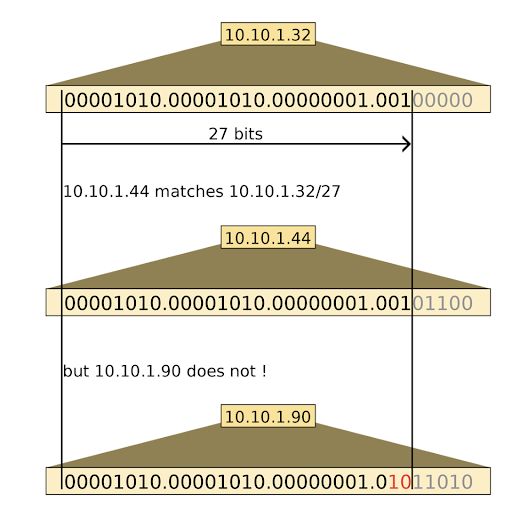
Figure 1: IP Address Matching
Routes are represented in CIDR notation, e.g. 10.10.1.32/27 where the 27 represents the number of bits in the network prefix (prefix length, a.k.a. cidr). This means that any IP address that has the same first 27 bits matches the route. In Figure 1, 10.10.1.44 matches the route 10.10.1.32/27 while 10.10.1.90 does not.
In the case that multiple routes match an IP address, the routing table returns the most specific route, or more rigorously, the route with the largest cidr value.
Thus, the routing table supports the following operations:
Insert(ip, cidr, router): associate the routeip/cidrwithrouterDelete(ip, cidr): remove the router associated with the routeip/cidr(if any)Lookup(ip): find the next-hop router forip
We refer to Inserts and Deletes as “updates,” or “update operations.”
Radix Tree
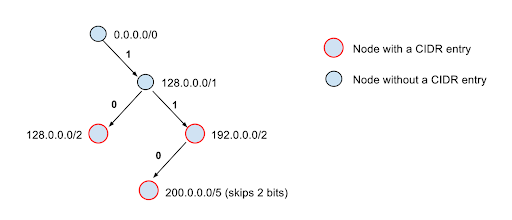
Figure 2: Structure of a Radix Tree
A commonly used data structure for the routing table is the radix tree, a specialization of a binary trie. Each node represents a route, but does not necessarily contain an entry if it serves only as a “branching point”. In the figure above, the nodes corresponding to the routes 128.0.0.0/2, 192.0.0.0/2, and 200.0.0.0/5 contain entries; the rest do not. As a space optimization, any node that is an only child is merged with its parent if the parent does not have an entry.
The cidr increases with depth, which means that the best match is the deepest entry associated with a matching route. The search complexity is thus O(k) where k is the number of bits in an IP address, i.e. k = 32 for IPv4 and k = 128 for IPv6.
Challenge
Update operations, comprised of inserts and deletes, can cause the structure of the radix tree to change in a non-trivial fashion. It is important to ensure that concurrent updates do not leave the tree in an inconsistent state. We also want to ensure that lookups do not view a tree in an inconsistent state.
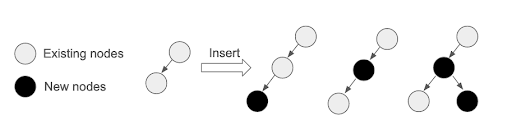
Figure 3: Possible outcomes after performing an insert operation with a new route
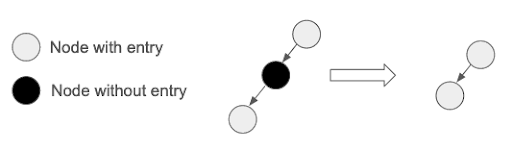
Figure 4: Parent with no entry is merged with an only child
One solution is to use synchronization primitives such as locks. With coarse-grained locking, a simple approach is to use a global read-write lock on the entire tree to ensure that multiple readers or at most one writer can access the tree concurrently. However, this severely limits parallelism especially when updates are more frequent.
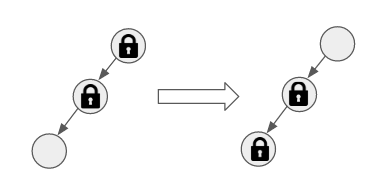
Figure 5: Hand-over-hand Locking
A better approach is to use fine-grained locking, where each node has a lock and threads only obtain locks when strictly necessary. We can perform hand-over-hand locking, where a lock is acquired on a parent and its child, and the lock on the parent is only released once it is deemed safe to do so – when we are confident that we do not need to backtrack to the parent, and that necessary updates to the parent have been made. Locks are acquired and released in this fashion as we traverse down the tree, enabling updates to operate concurrently on different portions of the tree.
Even better would be a lock-free implementation that guarantees system-wide progress even in the presence of multiple thread failures. We can use the compare-and-swap (CAS) instruction to achieve this, using the idea of marking individual child pointers from Velamuri [1]. This facilitates system-wide progress since any thread that is blocked by an ongoing operation can help to finish the ongoing operation before restarting. Furthermore, multiple threads can update a node simultaneously, improving parallelism. This is the approach that we will modify and present in this paper.
Resources
- Velamuri, V.S. (2017). Efficient Non-blocking Radix Trees. European Conference on Parallel Processing.
- Velamuri, V. (2017). Source code for efficient non-blocking radix trees. https://github.com/varun1312/RadixTrees
- Donenfeld, J. (2019). WireGuard for Linux 3.10 - 5.5. https://github.com/WireGuard/wireguard-linux-compat
- Donenfeld, J. (2018). Go implementation of WireGuard. https://github.com/WireGuard/wireguard-go
- McKenney, P. (2007, December 17). What is RCU, fundamentally?. Linux Weekly News. https://lwn.net/Articles/262464/
- Corbet, J. (2006, March 13). Trees I: Radix trees. Linux Weekly News. https://lwn.net/Articles/175432/
Goals and Deliverables
Plan to achieve
- Sequential implementation of radix tree
- Coarse-grained locking implementation of radix tree
- Fine-grained locking implementation of radix tree
- Lock-free implementation (CAS) of radix tree
- Utilities to generate workloads and test performance
- Test harness to check correctness of implementations
- Detailed comparison of radix tree performances under different workloads
Hope to achieve
- Userspace RCU lock-free implementation of radix tree, and comparison to CAS implementation
Demo: We will display graphs that demonstrate the speedup of the lock-free radix tree over the other implementations under different conditions.
The resultant data structure will be capable of concurrent lookups and updates while preserving integrity and correctness.
Platform Choice
Computer
- GHC machines for development and debugging
- PSC Bridges-2 “Regular Memory” machines for benchmarking heavy workloads
Language
- C++23 for
atomiclibrary
Schedule
| Week | Damian Ho | Jessica Ruan |
|---|---|---|
| Nov 6 - Nov 12 | Work on proposal Design radix tree interface Implement linked list / binary trie Add basic correctness tests |
Work on proposal Implement radix tree |
| Nov 13 - Nov 19 Project Proposal Due |
Complete and submit proposal Add stress tests Implement coarse-grained radix tree Implement fine-grained radix tree |
Write performance benchmarks Write workload generator |
| Nov 20 - Nov 27 | Read lock-free papers Implement lock-free (CAS) radix tree |
Read lock-free papers Implement lock-free (CAS) radix tree |
| Nov 27 - Dec 3 Milestone Report Due |
Benchmark implementations Complete milestone report |
Benchmark implementations Complete milestone report |
| Dec 4 - Dec 10 | Implement lock-free (RCU) radix tree Further benchmarking of implementations |
Implement lock-free (RCU) radix tree Further benchmarking of implementations |
| Dec 11 - Dec 15 Final Report Due Poster Session |
Complete final report and poster | Complete final report and poster |